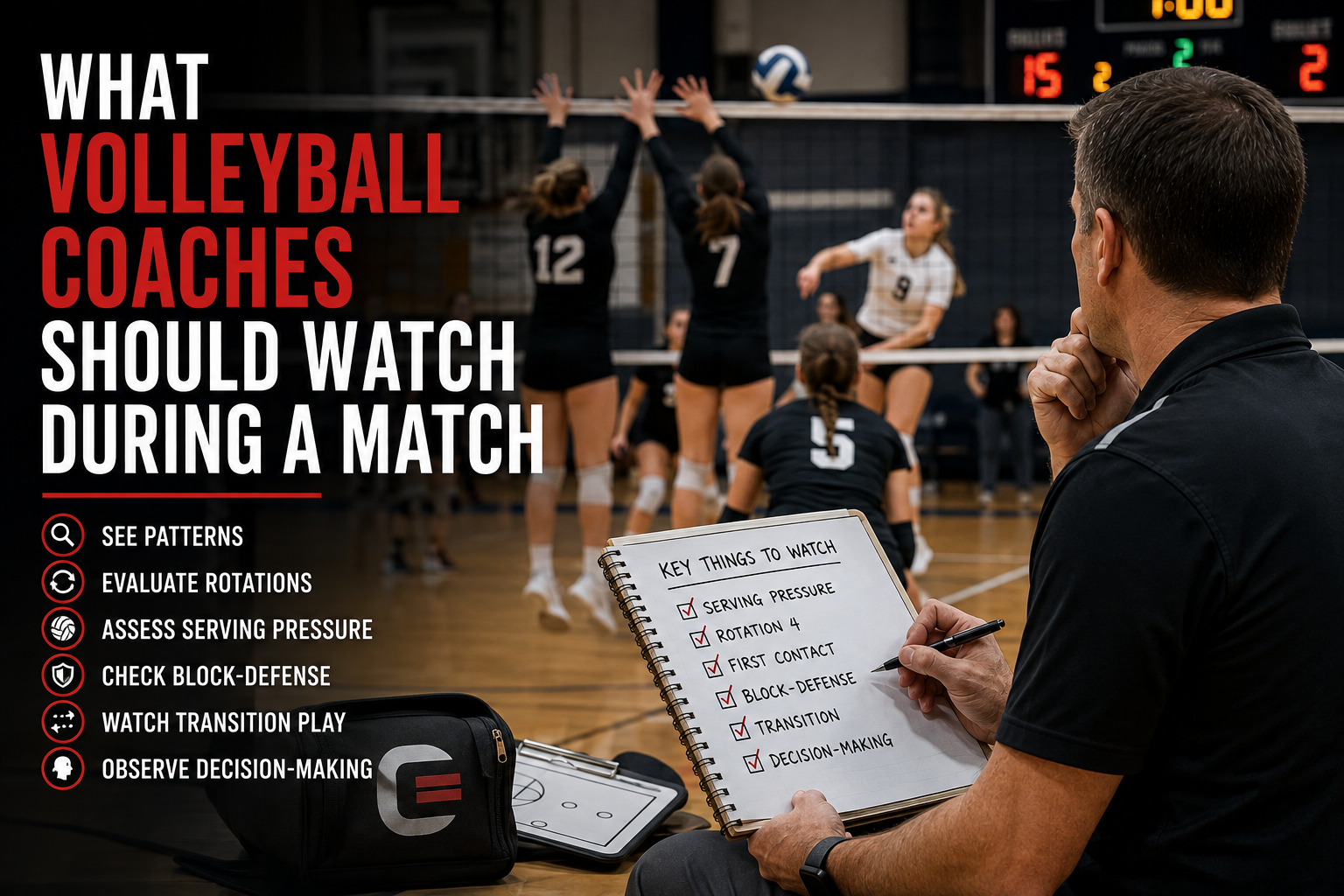
It’s surprisingly easy to watch a volleyball match without actually seeing very much. That might sound strange since you’re standing on the sideline watching every rally. The problem is that coaches’ vision is naturally pulled toward the ball. We see the serve, the pass, the set, the attack, and the result of the play.
That gives us information, for sure. It just doesn’t always give us the information we actually need. If we want to make useful decisions during a match, we need to look for patterns rather than simply react to individual rallies.
Don’t just watch whether you won the point
A rally ends and one team gets the point, obviously. That doesn’t tend to tell us very much, however.
Suppose your team wins a rally because the opponent misses an easy attack. Good result, but what happened before that? Did your serve create any pressure? Was your block organized? Were your defenders in the right positions?
You can win a point while doing several things poorly. You can also lose a point while doing most things well. The more useful question is:
What happened during the rally that is likely to matter again?
Look for repeated problems
One bad pass doesn’t necessarily mean you have a passing problem. One missed blocking assignment doesn’t necessarily mean your blocking system is breaking down, just as one poor attack choice doesn’t necessarily mean the hitter is making bad decisions.
What matters more is repetition.
Is the same passer getting targeted successfully? Are you repeatedly giving up points in one rotation? Is the opponent consistently finding the same defensive seam? Are your hitters repeatedly attacking into a well-formed block?
Patterns tell you where the meaningful issues are. Individual plays create noise. The better you can separate the two, the better your decisions are likely to be.
Pay attention to rotations
Rotations give you a useful way to organize what you’re seeing. If your team struggles in one rotation, though, don’t immediately assume the rotation itself is the problem. Look at why.
Maybe the serve receive formation is creating difficulty. Perhaps your setter is starting too far from the target, or one front-row combination isn’t producing enough attacking options. It could also be that your serving in that rotation isn’t creating enough pressure, allowing the opponent to side out comfortably.
Or there may be no structural issue at all. The rotation might simply have given up a few points.
That’s why tracking the pattern matters. It’s when a rotation repeatedly produces the same kind of problem that you probably have something worth addressing.
Watch what your serve actually does
Coaches often evaluate serving by whether the serve goes in. That’s obviously important, but it isn’t enough.
The more useful question is whether your serving strategy creates the problem you want it to create. Does it move the setter off the net? Do you force predictable attacking options? Does it make the opponent use a weaker passer or disrupting their preferred first-tempo attack?
A serve can be in and still accomplish very little. Similarly, an aggressive serve that occasionally misses may still produce the kind of pressure you want.
You need to evaluate the serve within the broader goal of your serving strategy.
Watch the first contact
The same idea applies on your side of the net. It’s easy to look at a bad attack and blame the hitter, but often the real problem came much earlier.
Was the pass good enough to give the setter options? Did the setter have to chase the ball? Did the hitter get the tempo or location they expected?
Sometimes the play is already compromised before the attacker ever touches the ball.
First contact affects almost everything that follows, which makes it one of the most important things to watch when you’re trying to understand why your offense is or isn’t working.
Watch the block-defense relationship
Another area where coaches can focus too narrowly is blocking. If the opponent gets a kill, the natural reaction is to look at the block, but the question isn’t simply whether the blocker touched the ball. You need to look at how the block and defense are working together.
Did the block take away the intended area? Were the defenders positioned based on the block? Did the attacker score because the block failed, because the defense was out of position, or because the attacker simply made a very good play?
A block can do its job without touching the ball. Likewise, a defender can be in the right position and still get beaten by an excellent attack.
What matters is whether your system is consistently putting players in reasonable positions to make plays.
Watch what happens after the first defensive contact
Teams often focus heavily on making the dig, which is understandable. The dig, however, isn’t the end of the defensive phase. It’s the beginning of transition offense.
If your team digs a lot of balls, but fails to create useful attacks afterward, you need to understand why. Are players transitioning quickly enough? Is the setter available? Are attackers creating enough spacing? Are you defaulting to predictable high balls?
A team can defend reasonably well and still struggle to score because the transition phase is poorly organized. That’s a different problem from poor defense, and you need to see the difference.
Watch player decision-making
One of the most important things you can observe during a match is whether players are solving problems themselves.
Do they recognize where the opponent is vulnerable? Are attackers adjusting to the block? Do defenders adapt to repeated tendencies? Does the setter recognize which matchups are working?
You should also pay attention to the information players are sharing between rallies. Useful communication is often a sign that they’re actually reading what’s happening rather than simply executing instructions.
You don’t want to be the only person on the team identifying problems. If the players can see and solve them, the team becomes much more adaptable.
Be careful with emotional reactions
Matches create emotional noise. A long service run feels significant, a missed serve at 23-23 feels more important than one at 5-5, and a spectacular kill tends to stick in the memory.
Those moments matter emotionally, but they don’t always matter tactically.
A shanked pass may look worse than several average passes that quietly limit your offense. A big block may get everyone excited even if your block-defense system has otherwise been poor.
That’s one reason it can help to write down a few observations rather than relying entirely on memory. You don’t need a complicated statistical system. A few simple notes can help you determine whether something is genuinely happening repeatedly.
Decide what actually needs intervention
Seeing a problem doesn’t automatically mean you need to intervene. Sometimes players already know what happened and are fixing it themselves. Sometimes the issue is obvious but temporary. Other times the pattern is clearly getting worse and needs attention.
Before calling a timeout, making a substitution, or giving a tactical instruction, ask:
Is my intervention likely to improve what happens next?
That helps keep you from coaching simply because something went wrong.
Watch the opponent too
It sounds obvious, but coaches can become so focused on their own team that they stop paying attention to what the opponent is doing. Look for patterns there as well.
Who are they trying to serve? Where does their setter go under pressure? Which attackers are getting the highest-quality opportunities? What happens when they’re out of system? You can also watch how they defend different attack locations, whether they make predictable substitutions, and how they respond after a timeout.
The goal isn’t to identify every possible tendency. It’s to find the few patterns that might actually influence what your team does.
Give yourself something specific to watch
Trying to watch everything usually means you don’t watch anything particularly well. It helps to give yourself one or two specific observational priorities.
Maybe you want to track whether your serve is creating the intended pressure. Perhaps you want to focus on one rotation that has been problematic, or watch transition spacing more closely.
You can still see the rest of the match. The difference is that you’re deliberately looking for something that matters.
Use the match to learn, not just manage
Coaching during a match is partly about making decisions in the moment. It’s also about collecting information. What you see should help inform substitutions, timeouts, tactical adjustments, and the conversations you have with players.
It should also feed directly into future training. In this regard I often think about matches as exams telling us how well our training has been working. That makes match observation part of the practice-planning process. The better you become at identifying meaningful patterns during competition, the better information you have afterward.
And that ultimately helps answer the same question that should drive your training:
What does this team most need next?