

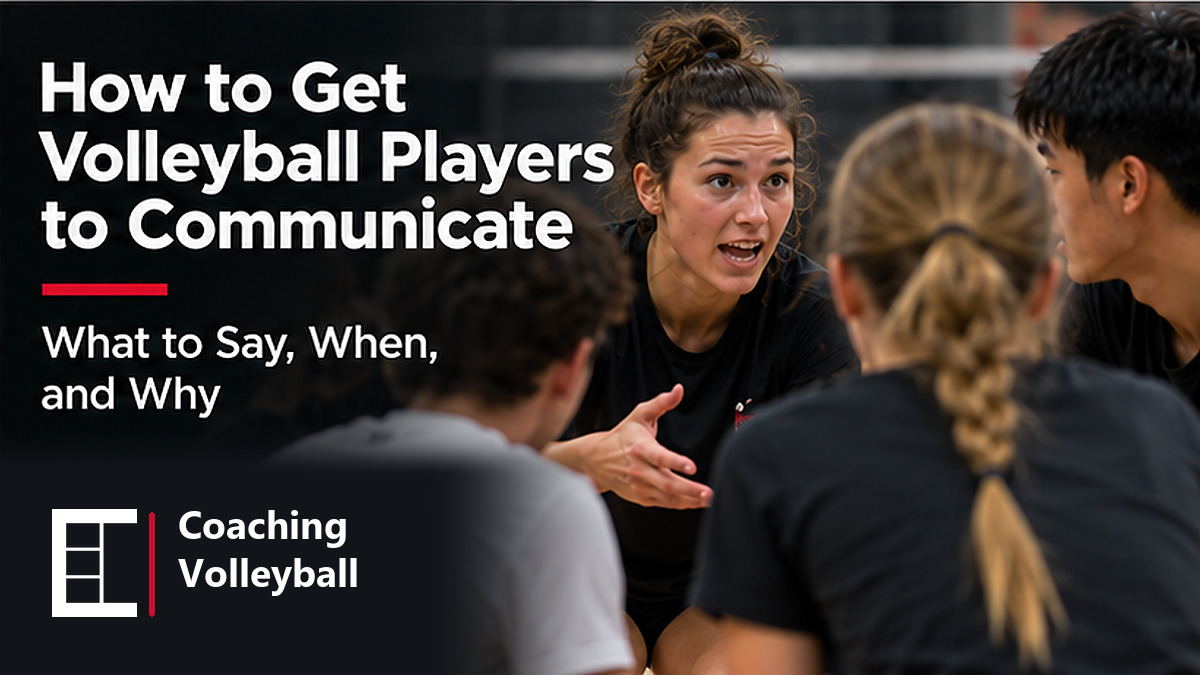
“Talk more!” is one of the easiest things to shout from a volleyball sideline.
It’s also not very helpful if players don’t know what information their teammates need or when they need it.
A loud team can still be a confused team.
I tend to judge communication by a simpler standard: did it help someone make the next decision? Sometimes that’s a word during the rally. Sometimes it’s a quick conversation before the serve. Sometimes the useful information is conveyed by movement rather than a call.
The goal isn’t constant noise. It’s better coordination.
Teach the responsibility before demanding the call
A lot of communication problems are actually responsibility problems.
Two passers let a serve land between them and the coach says, “You have to talk!” Maybe. But if neither player knows who owns that seam, shouting at the last second doesn’t solve much.
Decide the rule first. Then teach players to recognize when the incoming ball belongs to them.
That’s the point behind Whose ball? Seam responsibilities. A shared rule is more useful than hoping somebody wins a verbal race as the ball drops.
I don’t object to a newer player calling “mine” as confirmation. I do object to treating the call itself as the skill.
Sometimes a player’s first movement gives a teammate all the information they need. Sometimes a call genuinely resolves uncertainty. I explored that distinction in To call the ball or not to call the ball.
Use the time before the serve
Many useful volleyball conversations should happen before the rally starts.
Passers can confirm a seam or short-ball responsibility. Setters and hitters can clarify availability. Blockers and defenders can agree on what they’re taking away against a particular attacker.
That’s much easier than trying to solve an alignment problem after the ball is already in flight.
The exchange doesn’t need to be long. “Short seam is mine; you have deep” may be enough if both players attach the same action to those words.
That’s the important part. The exact vocabulary matters less than whether teammates mean the same thing.
If “short” means one thing to the libero and something else to an outside hitter, the call creates another problem. Demonstrate the responsibility, then use the language consistently in live play.
During the rally, useful information has a short shelf life
Some calls matter because a teammate cannot see what you can see.
A blocker may identify a tip. A defender may see that there is no block. A hitter can tell the setter they’re available. Someone has to organize second contact when the setter digs the first ball.
But the information has to arrive early enough to change the next action.
That’s why I would define second-ball responsibility before it happens. If the setter makes first contact, who normally takes the second? Does the answer change when the libero is closest or when a front-row player has a better option?
You need a default and a quick way to handle exceptions. The setter role guide covers the setter’s wider job, but this particular problem belongs to the whole team.
I also wouldn’t script every phrase. “Help,” a player’s name, or “outside” can all work if the meaning is clear.
The question I like is, “Did that call tell you something you needed to know?” If not, we’re probably training noise.
Block-defense communication should update the shared plan
Communication matters most when the rally stops looking like the picture you drew beforehand.
Suppose the block is taking line. The backcourt should already know what space that leaves them. Now the middle arrives late and a seam opens. Somebody may need to adjust.
The same thing happens in transition. A defender makes the dig, the setter is out, and another player has to organize the second ball. Or a blocked attack changes who can transition to hit.
Useful communication helps the group update its shared plan.
That is different from narrating everything that happens. A late call after everybody has already reacted doesn’t add much. A short early call that changes positioning can be very valuable.
Between rallies is where many of the best conversations happen
Players often have more useful information after the rally than during it.
“They’ve served that short seam twice. What are we changing?” is a real problem the passers can solve. “The setter keeps using the quick on tight passes. What are we seeing?” can help the block and defense adjust together.
Those conversations are more useful than a generic demand for energy.
An experienced libero, setter, or captain may lead the exchange, but they don’t have to be the only voice. The player being targeted or the defender who sees the block may have the most relevant information.
I want players to recognize problems and test solutions themselves. That’s part of the idea behind developing self-organization.
If I interrupt every discussion with my answer, I take away some of the decision-making I’m trying to develop.
That doesn’t mean the coach stays silent no matter what. I step in when the group lacks an important principle, can’t reach a useful solution, or keeps repeating the same problem.
Train communication inside the problem it serves
If you want better seam communication, serve repeatedly into a seam and let the passers work from their rule.
If you want players to organize second contact, start some rallies with the setter taking first ball. If you want better block-defense communication, give the offense more than one attack option and let the defense adjust between rallies.
Those situations create a reason to communicate.
That matters because you can easily train the wrong thing. Give a bonus point every time somebody shouts “mine” and you’ll probably get more shouting. You won’t necessarily get better passing.
Instead, look at the action that followed the information. Did the players move earlier? Did two people make the same read? Did the next contact improve?
With younger players, you may start with something simpler. Getting young players to communicate and move offers one example. Then put the same responsibility into a live serve, attack, or transition.
The communication has to survive the uncertainty of the game.
Measure quality, not volume
After a communication breakdown, I would ask three things.
- Was the information useful?
- Did it arrive early enough to change what a teammate did?
- Did the teammate understand and respond?
Those questions help separate a missing team rule from a late call or an execution error.
It’s also worth watching a few rallies without saying anything from the sideline. Do the passers settle seam questions before the serve? Does somebody organize second ball when the setter is out? Do defenders adjust when the block changes?
You may find that a relatively quiet team is coordinating well. You may also find that a loud team is saying very little that affects play.
So I wouldn’t make “talk more” the objective. Teach the responsibilities, create situations where players need useful information, and give feedback on the decisions that follow.
When the communication actually helps them solve volleyball problems, the volume usually takes care of itself.

One Response
Great Article as always!