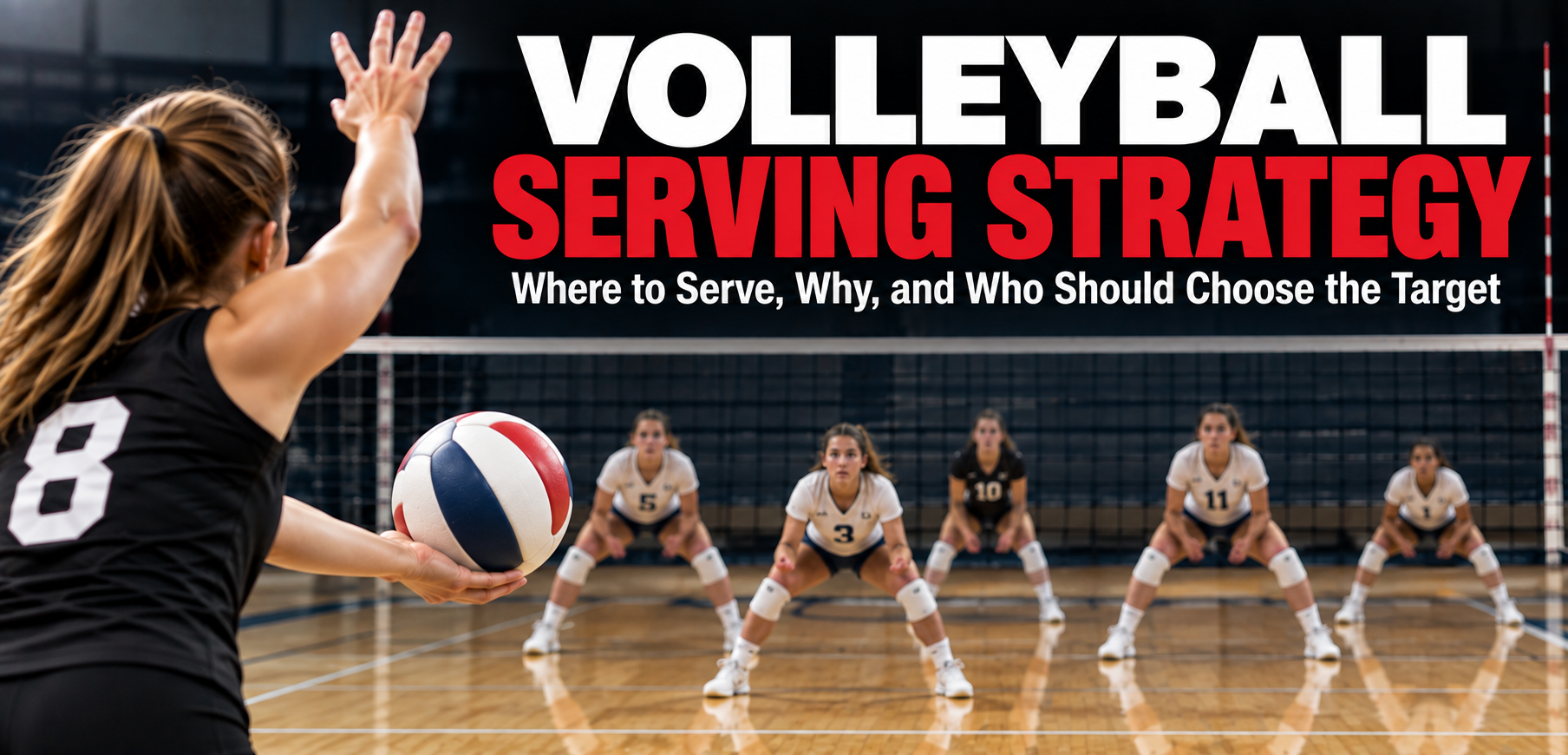
Serving strategy is often reduced by coaches to a fairly simple idea: find the weakest passer and serve them. There are definitely times that makes sense. If there is a clear weak passer, repeatedly putting them under pressure can be very effective.
But serving strategy should be about more than picking the passer with the lowest rating. You also have to think about what your server can actually execute, what effect you want the serve to have on the opposition offense, and how the receiving team is arranged in a particular rotation.
And then there is another question – who should actually decide where the ball goes?
Start with what your server can actually do
Before worrying about the opposition, start with the person actually serving the ball.
Different players have different serving capabilities. One may have a very effective deep serve into Zones 1 and 6, but struggle with Zone 5. Another may be particularly good at dropping the ball short. Someone else might generate enough pace that simply hitting their preferred area aggressively creates more problems than trying to pick out specific locations. This matters.
Suppose your scouting tells you the opponent’s weakest passer is in Zone 5, but your server’s weakest target is Zone 5. Does it make sense to ask them to put the ball there?
Maybe, if the weakness of the passer is large enough. Quite often, though, you’re better off having the server use their strongest serve against a slightly better passer. I discussed this in more detail in Is calling service targets beneficial?.
There’s a tendency for coaches to think first about the ideal target and only then about the ability of the server to hit it. I think we should maybe reverse that – while training our players to be able to serve effectively to any part of the court, and from anywhere beyond the end line.
What are you trying to accomplish?
Serving tough isn’t really an objective in itself. You’re trying to make the opponent’s offense less effective.
An ace obviously does that rather well, but most serves aren’t aces. The more real objective is to create a situation from which the receiving team has a lower probability of siding out.
There are several ways you might accomplish that.
- Attack a weaker passer.
- Force a particular player to receive and then transition to attack.
- Put the setter in an awkward movement pattern.
- Try to eliminate or reduce the effectiveness of a middle attack.
- Serve to an area which tends to produce a more predictable set.
Those objectives don’t necessarily lead to the same target. That’s why simply saying “serve the weakest passer” doesn’t really constitute much of a serving strategy.
Sometimes a bad pass isn’t enough
I once watched a men’s match where a server repeatedly targeted the opposition’s weakest passer. On the surface, it made perfect sense. The guy was not a good passer at all.
The problem was that he was by far the opponent’s best attacker as an OH.
The serve frequently produced an imperfect pass, as intended, but the direction of the pass actually made the resulting set fairly predictable. The setter ended up putting the ball outside to the player they most wanted attacking anyway.
The serving team had succeeded at creating poor passes without succeeding at creating a particularly useful situation. I wrote about that example in When not to serve their weakest passer.
The important point is that pass quality is only an intermediate outcome. Ultimately, you care about what happens to the opposition’s ability to score. A serve that produces a 2-pass followed by a highly efficient attack isn’t necessarily better than one that produces a 3-pass but disrupts the offense in some other useful way.
Think about the offense, not just the passers
This is where serving strategy becomes more interesting.
Imagine an opponent whose setter struggles to run a fast offense when the ball is passed from behind them. You might therefore target Zone 1 even if the passer there isn’t particularly weak.
Or perhaps a team relies heavily on its middle attacker. A short serve that forces that player into the reception pattern or delays their approach might be useful even if it doesn’t produce a bad pass.
Serving deep toward a front-row outside hitter can create similar issues. The objective isn’t necessarily to ace them, but rather to make their transition into attack more difficult.
These are all examples of serving to influence what happens after reception rather than simply trying to lower the passing score.
Serving strategy should change by rotation
The best serving target probably isn’t the same in all six rotations. Passers move. Setters move. Front-row attacking options change. Reception formations change. That means the consequences of serving a particular area also change.
Perhaps Zone 1 is a strong target in one rotation because it puts the setter under movement pressure. In another rotation, the setter is already positioned differently and the same serve accomplishes very little. A short serve might be useful when a particular middle is front row, but less important when that player rotates out.
This is why I prefer thinking in terms of the problem you’re trying to create rather than simply assigning a fixed target to a player for the entire match.
Players are targets too
Coaches often talk about serving zones, but there is a difference between serving an area and serving a person. Sometimes you want the ball in a particular part of the court regardless of who takes it. Other times the objective is to force a specific player to make the first contact.
Those aren’t always the same thing.
You might even want to serve into a seam specifically because you’re trying to create uncertainty between two receivers rather than target either player individually.
There are plenty of ways to define court locations. Most coaches use the standard six zones and perhaps add seam targets. You can get much more detailed if you want, as I outlined in Advanced volleyball serving zones.
The level of detail isn’t the important part, though. The players need to understand what the target is intended to accomplish.
Don’t sacrifice serving quality for tactical precision
This is probably the biggest caution I would offer. An optimal target only matters if the server can hit it with sufficient quality.
A player may be capable of putting a ball into a particular zone, but doing so might require them to take so much off the serve that the tactical advantage disappears. I’ve definitely seen this.
A coach signals a short serve and gets a soft ball that lands short but causes no real difficulty. Or the coach calls for Zone 1 and the server delivers a comfortable standing float because they’re so focused on accuracy.
Technically, the player hit the target. Strategically, the serve achieved nothing.
I generally want players to develop an aggressive comfortable serve first. From there, we can expand the range of areas they can attack without sacrificing too much serving quality.
The ability to hit targets is useful. It shouldn’t come at the expense of actually putting pressure on the opponent, though.
Who should choose the serving target?
When I was a young college assistant coach I always signaled serving zones from the bench. It was part of the scouting process, and it seemed perfectly normal that the coaching staff should decide where the ball went.
In progressing my coaching and thinking, though, I stepped back a bit from that. As I wrote in To Call Service Targets, or Not to Call Targets, this is largely a player-development issue for me.
Also, it’s hard to avoid the realization that calling service targets is a way for a coach to feel they can control something during a match when there’s so much they can’t. We should feel like we need that sense of control.
I want players – especially younger ones – learning to identify what is happening on the other side of the net and make useful decisions themselves. Players constantly have to read, decide, and adapt. Serving presents a very good opportunity to develop those abilities because there is time before every rally to assess the situation.
If I’m constantly telling players where to serve, they have little reason to develop that part of their game.
That doesn’t mean coaches shouldn’t call targets
There are certainly times when I give a specific serving instruction.
Perhaps we’ve identified something in scouting that I want reinforced. Maybe I’ve noticed a change in the opponent’s reception pattern. It might simply be that the server hasn’t recognized something I think is important.
Even then, though, I’d often rather point out what I’ve seen than just give the player the answer. Instead of saying “Serve 1,” I might draw their attention to where the setter is starting or where a particular passer has moved.
That creates an opportunity for the player to reach the conclusion themselves.
There are also players and teams for whom more direction makes sense. Younger or less experienced players may not yet have the ability to recognize useful serving opportunities. In that case the coach can provide more guidance while gradually shifting responsibility toward the players.
At the other end of the spectrum, you might take the serve decision-making away from high level players to allow them to save that work for things like hitting and setting choices. I expect my teams to use their brains a lot when they play. Reducing the cognitive load by giving them serving targets provides a bit of a break in that regard.
Make serving strategy part of practice
If you want players making good serving decisions in matches, they need opportunities to make them in practice. Simply telling players to “serve tough” won’t develop much tactical awareness.
When you’re playing 6v6, ask servers what they’re looking at. Have them identify the reception formation. Ask what they think serving a particular area is likely to accomplish.
You can also create specific problems.
Give one side a strong middle attack and ask the serving team how they might limit it. Put a weaker passer in a particular rotation and see whether servers recognize the opportunity. Change the reception formation and ask what that does to their target selection.
Now serving becomes part of the tactical game rather than something that simply starts the rally.
Have a plan, but don’t become trapped by it
Scouting can give you useful serving targets before a match. That’s a good starting point. But it’s still only a starting point.
Maybe the player you identified as the weakest passer is passing extremely well that day. Perhaps a different player is struggling. We’ve all experienced that sort of thing with our own teams!
Maybe the opponent has changed its reception formation or the setter is making different decisions than expected.
Your players need to recognize those things. So do you.
Serving strategy should adapt to what is actually happening, rather than continue blindly because something was written on the scouting report.
The best target depends on the situation
There isn’t one answer to where you should serve.
The weakest passer might be the right target. A seam might be better. A particular zone might disrupt the setter or remove an attacking option. Or the best decision might simply be to let your server hit their strongest serve into the area where they feel most confident.
The important thing is understanding why you’re making the choice. For me, a useful serving decision comes down to three things:
- What problem are we trying to create for the opposition?
- What can this particular server execute effectively?
- What is happening in this rotation right now?
If coaches and players are thinking about those questions, serving becomes much more than putting the ball in play or aiming at the weakest passer. It becomes the first tactical action of the rally.