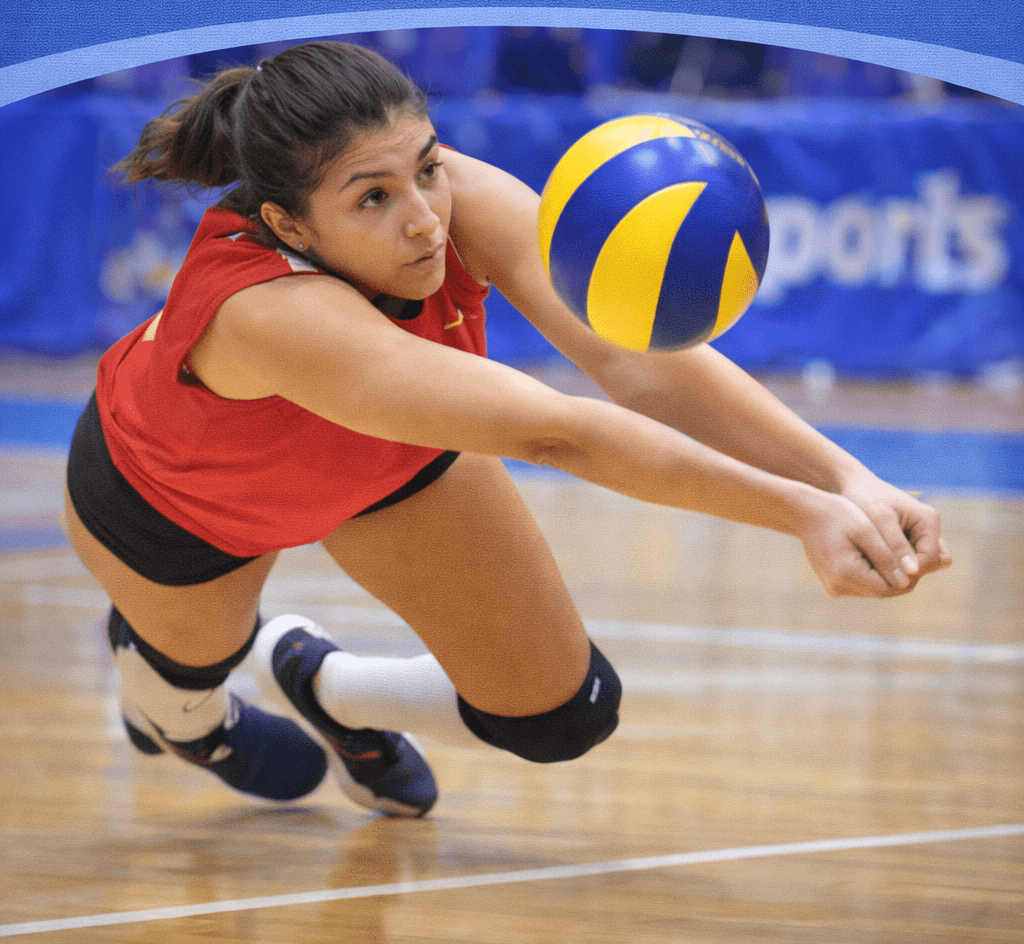
A libero is a back-row defensive specialist whose main job is to improve first contact and backcourt defense. The libero uses special replacement rules rather than normal substitutions, and you can usually identify them by the contrasting jersey.
The basic concept is fairly simple, though the details aren’t universal. Serving, replacements, and the number of designated liberos can vary by rule set. Coaches therefore need to know which rules govern their competition.
What does a libero do?
The libero normally replaces a player when that player reaches the back row. Middles are the most common example.
Teams often prefer the middle’s blocking and attacking in the front row, then use the libero’s passing and defense behind them.
The libero doesn’t change the team’s rotation order.
Your six rotational positions still move normally. The libero replaces an eligible back-row player, then leaves when that player needs to return to the front row.
That distinction matters because the libero isn’t a seventh player who rotates independently around the court.
The basic libero restrictions
Across the major indoor rule sets, several things are consistent.
A libero can’t block or attempt to block. They also can’t complete an attack hit when the ball is entirely above the net.
The setting rule causes more confusion.
A libero can set the ball with their hands. The issue is what happens after an overhand finger pass from the front zone.
Under NCAA, USA Volleyball, and FIVB rules, a teammate can’t complete an attack above the net from that ball. The same overhand set from behind the front zone doesn’t create that restriction.
So “the libero can’t hand set in front of the attack line” isn’t really the rule.
They can make the contact, but it changes what their teammate is allowed to do next.
That changes how I’d teach the situation. A libero clearly behind the attack line can use their hands without creating the restriction. Near or inside the front zone, a forearm set is often the simpler choice.
Can a libero serve?
This depends on the rule set, so I’d avoid any blanket statement that liberos always can or can’t serve.
Under current NCAA women’s rules, a libero may serve in one rotation. If two liberos are designated, they can’t serve in two different rotations.
NFHS now allows up to two designated liberos, though libero service remains tied to one serving position. USA Volleyball also permits libero service in one rotational position. FIVB, meanwhile, continues to prohibit libero service.
Know your competition rather than assuming the rule you’re familiar with applies everywhere.
How libero rotations work
Suppose you use your libero for both middle blockers.
MB1 plays the front row, then the libero replaces them when MB1 reaches the back row. When MB1’s position returns to the front row, MB1 comes back and the libero leaves.
The libero can later replace MB2 when that player reaches the appropriate back-row position. The exact replacement procedures depend on the rule set.
Those details matter to scorers and officials, but the coaching concept is straightforward. The team rotates normally while the libero replaces eligible back-row players.
If rotation itself is confusing, start with the Rotations, Lineups & Court Mapping guide. It’s easier than trying to learn rotation through the libero rules.
What makes a good libero?
A good libero does more than make spectacular digs.
The first thing I generally care about is first-contact quality. Can the player handle good servers repeatedly and give the setter a useful ball?
From there I look at reading. Good defenders aren’t simply fast after the attacker contacts the ball. They recognize useful information early enough to improve their position before contact.
Second-ball ability matters as well. When the setter takes first contact, the libero is often one of your next options. A hittable out-of-system set can turn a broken rally into a legitimate scoring chance.
Communication matters too because the libero is involved in seams, defensive responsibilities, coverage, and transition organization on many rallies.
The role combines ball control with decision-making rather than simply being “the defensive position.”
Choosing a libero
If you’re deciding between players, I’d start with what matters most for your particular team. For many teams, that means serve receive.
Which player most improves the quality and stability of first contact?
From there, look at defense, second-ball quality, reading, communication, and composure.
I’d be careful about choosing the player who simply looks the most active on defense. Diving more often doesn’t necessarily mean defending better. Sometimes it means the player was late getting where they needed to be.
The better question is which player makes your first contact and transition game more reliable.
For more on that selection decision, see Picking your libero.
Training the libero
I don’t think the libero needs a separate universe of drills, but they do need the right kinds of problems.
That includes reading real serves, handling seams, defending against meaningful attacking options, and transitioning after first contact. It also includes taking second ball when the setter is unavailable.
If you want better reading, give the player information worth reading. And if you want better decisions, give them actual choices.
That’s more useful than accumulating “libero reps” that remove the parts of the game the libero needs to interpret.
Libero or defensive specialist?
A defensive specialist enters through your normal substitution rules. A libero operates under separate replacement rules and has the restrictions discussed above.
That difference affects how you can use the player tactically, so the labels aren’t simply two names for the same role.
The bigger question is what combination gives your team the strongest first contact and backcourt play without creating problems elsewhere.